Category: Artificial Intelligence
By InvuEdge Editorial Team
Artificial intelligence is no longer just another technology trend—it’s becoming one of the biggest drivers of business growth. Over the past few years, companies have experimented with AI tools, but in 2026, the conversation has changed. The focus is no longer on whether businesses should invest in AI. Instead, it’s about how fast they can turn those investments into real results.
What’s even more interesting is who’s leading the charge.
Today, CEOs are stepping into a much bigger role when it comes to AI. Rather than leaving decisions to IT departments or technology teams, many business leaders are taking direct responsibility for their company’s AI strategy. They understand that AI isn’t just about software—it’s about reshaping the way an entire organization works.
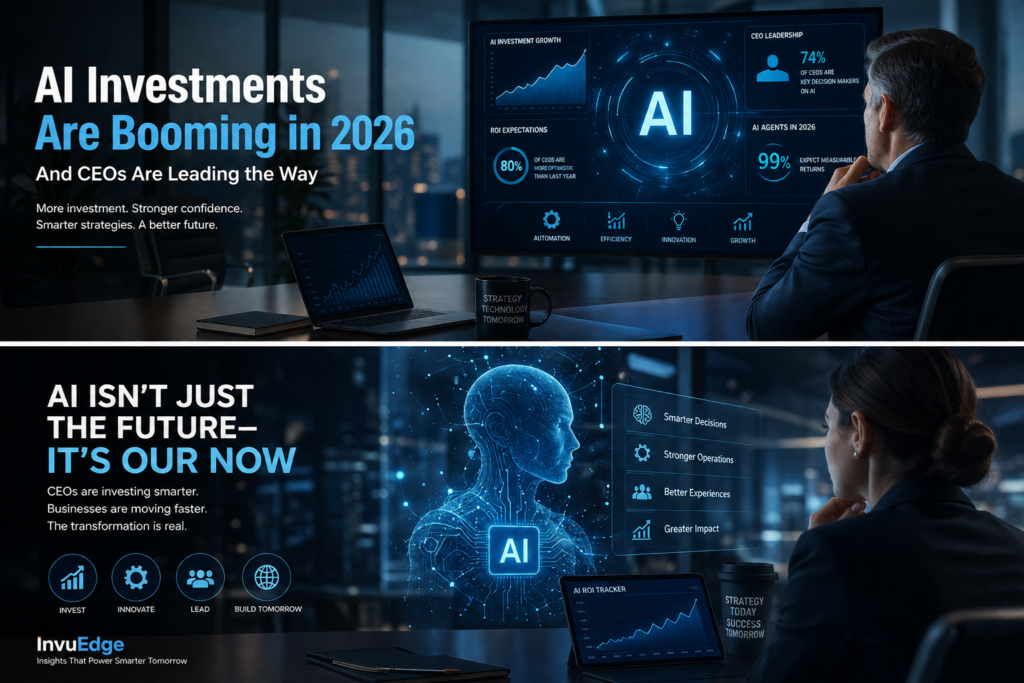
Why CEOs Are Getting Involved
Artificial intelligence now influences almost every part of a business. It can improve customer service, automate repetitive tasks, help employees work more efficiently, and even support better decision-making through data analysis.
Because AI touches so many areas, business leaders can’t afford to treat it as just another IT project. It has become a strategic priority that affects operations, company culture, innovation, and long-term growth.
For many CEOs, leading AI initiatives is no longer optional—it’s part of their job.
Companies Are Spending More on AI
Businesses around the world are increasing their AI budgets at a remarkable pace.
Instead of experimenting with a few pilot projects, organizations are making AI a core part of their business plans. Investments are flowing into technologies such as:
- AI-powered customer support
- Business automation
- Intelligent data analytics
- Content creation tools
- Software development assistants
- AI agents that can perform complex tasks
Companies believe these investments will help improve productivity, reduce operating costs, and create better experiences for both customers and employees.
Confidence in AI Has Never Been Higher
Not long ago, many companies were unsure whether AI would deliver meaningful business value.
That uncertainty is beginning to fade.
As AI tools become more accurate and capable, business leaders are growing increasingly confident that their investments will pay off. Organizations are already seeing improvements in efficiency, faster workflows, and smarter decision-making.
Instead of viewing AI as an experimental technology, many executives now see it as a long-term competitive advantage.
AI Agents Could Change the Way We Work
One of the biggest developments this year is the rise of AI agents.
Unlike traditional chatbots that simply answer questions, AI agents are designed to complete tasks on behalf of users. They can analyze information, write reports, schedule meetings, organize workflows, and even assist with software development.
Think of them as digital coworkers rather than digital assistants.
As these systems continue to improve, businesses expect AI agents to handle more routine work, giving employees more time to focus on creative thinking, problem-solving, and innovation.
Success Isn’t Just About Buying AI
While companies are investing heavily in AI, technology alone won’t guarantee success.
Organizations also need clear strategies, skilled employees, and responsible governance. Protecting customer data, reducing AI bias, and ensuring transparency remain important priorities.
Businesses that balance innovation with responsible AI practices are more likely to build trust and achieve sustainable growth.
Looking Ahead
Artificial intelligence is quickly becoming one of the most important business technologies of this decade.
The companies that succeed won’t necessarily be the ones spending the most money. They’ll be the ones that integrate AI thoughtfully, empower their employees, and focus on solving real business problems.
For CEOs, AI is no longer just another item on the agenda—it’s becoming a key part of how they lead their organizations into the future.
Final Thoughts
The AI race is no longer about experimenting with new technology—it’s about transforming the way businesses operate.
With CEOs taking a more active role and companies increasing their investments, 2026 is shaping up to be a defining year for artificial intelligence. The organizations that combine strong leadership with smart AI adoption will likely be the ones setting the pace for the next generation of innovation.
Leave a Reply